02Yoga blankets
Blankets are used for warmth in relaxation, folded under hips and knees for support, and rolled under necks. They take sweat, skin oils and hair, and they are used close to the face.
Cotton blankets
Cotton blankets, including the popular woven styles, can usually be machine washed. Wash them warm with a measured detergent dose, rinse well and dry fully. They may shrink a little in the first washes, so allow for that when buying.
Wool blankets
Wool blankets are warm and feel lovely, but most wool shrinks and felts in a normal machine wash and tumble dryer. Many studios air wool blankets regularly, spot clean marks and send them for specialist cleaning occasionally, rather than washing them weekly. If a wool blanket's label says it can be washed, follow the label exactly, usually cool and gentle with no tumble drying.
Woven acrylic and blended blankets
Brightly coloured woven blankets are often acrylic or a blend. They are usually machine washable on a cool to warm setting and should be dried gently; high heat can make acrylic go limp or pill.
How often
Blankets used directly against skin should be washed regularly, more often in busy studios and hot classes. Many studios wash blankets weekly and after any class where they were used heavily.
Folding and storage
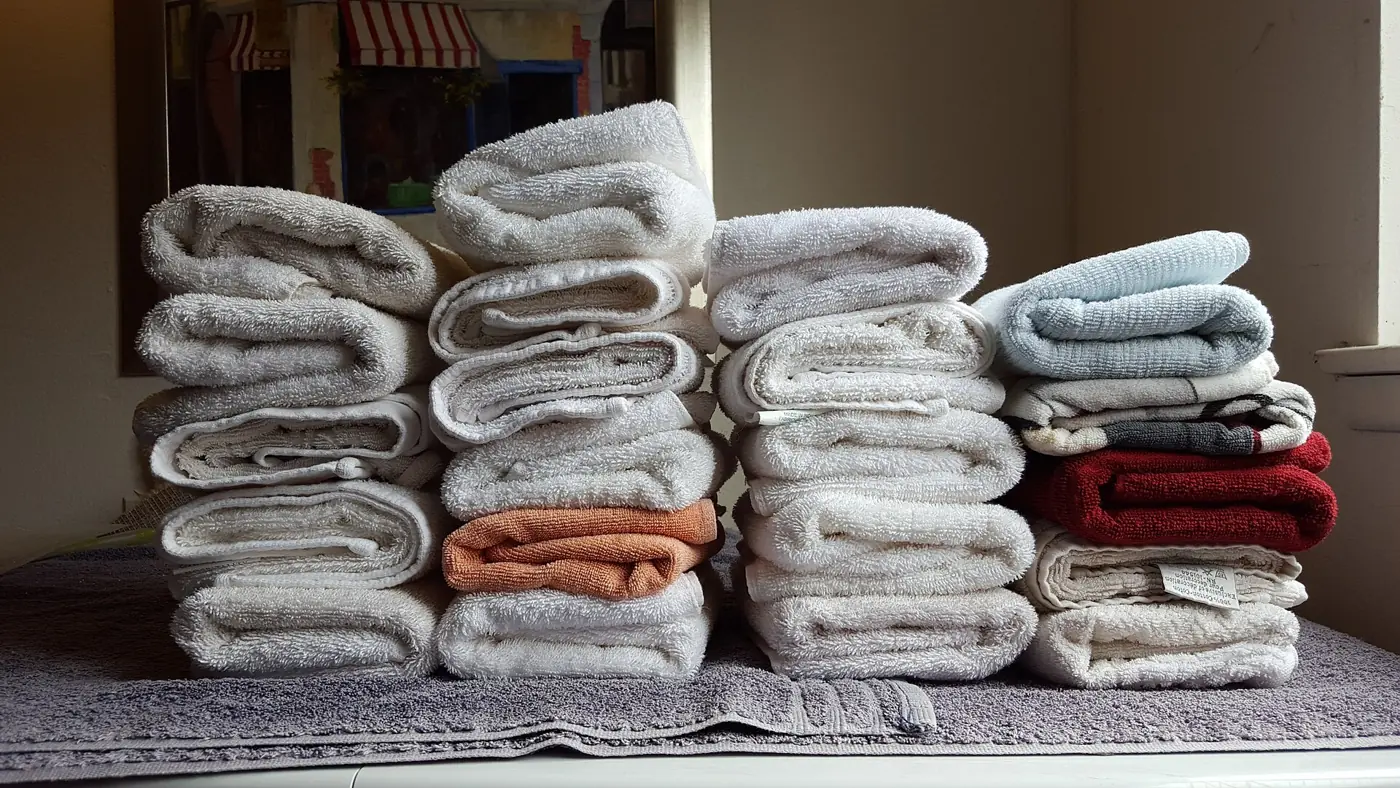
Blankets look best folded the same way and stacked neatly on open shelves, where air can reach them. Damp blankets folded into a closed cupboard will smell.
03Mat towels
Mat towels sit on top of yoga mats to absorb sweat and improve grip, especially in hot yoga. Many are microfibre, some with silicone dots on the underside for grip.
Washing
- Wash mat towels separately from cotton items, which shed lint that clogs microfibre.
- Do not use fabric softener; it coats microfibre and reduces grip and absorbency.
- Wash at the temperature on the label; very hot washes can damage microfibre and silicone dots.
- Rinse thoroughly.
Drying
Tumble dry on low heat or air dry. High heat can melt or loosen silicone dots and make microfibre feel rough.
After every use
Mat towels are soaked after hot classes. They should be washed after every use, not stacked damp for the next class.
04Bolsters, cushions and eye pillows
Bolsters and cushions support the body in restorative poses. Their fillings, such as cotton batting, foam, buckwheat hulls or kapok, are rarely washable. Their covers often are.
Removable covers
Choose bolsters and cushions with removable, washable covers. Wash covers regularly, following the label, and dry them fully before putting them back on.
Inner covers
Some bolsters have an inner cover under the outer one. This protects the filling from sweat and is worth having.
Eye pillows
Eye pillows are often filled with flax seed or rice, sometimes with lavender. They must not be washed. Use washable eye pillow covers, or provide disposable covers, and change covers between users.
Meditation cushions
Meditation cushions with buckwheat fillings can have the cover removed and washed. Never wet buckwheat hulls; they can go mouldy.
05Straps and loops
Yoga straps and Pilates loops are usually cotton or polyester webbing, sometimes with metal or plastic buckles.
- Wash straps in a mesh bag so they do not tangle or damage other items.
- Fasten or protect buckles so they do not scratch the drum.
- Wash on a cool to warm cycle.
- Air dry or tumble on low heat.
Elastic resistance bands and loops are often rubber or latex and should be wiped clean, not machine washed.
06Blocks and mats
Blocks and mats are among the most-used props and the least washable.
Foam blocks
Foam blocks absorb sweat and oils. Wipe them with a mild cleaning solution suitable for the foam and let them dry. They cannot go in a washing machine.
Cork blocks
Cork is naturally resistant to bacteria to some extent but stains easily. Wipe with a damp cloth and let it dry fully. Avoid soaking.
Yoga mats
Most yoga mats should be wiped clean, not machine washed. PVC, TPE, natural rubber and cork mats each have their own cleaning advice. Natural rubber mats in particular can be damaged by harsh cleaners, oils and direct sunlight. Follow the maker's guidance.
Wiping between classes
Many studios wipe mats after every class with a suitable spray and cloth, and do a deeper clean weekly. The cloths used for this should be treated as cleaning cloths, not towels.
07Boxing hand wraps
Hand wraps protect the hands and wrists inside gloves and absorb a lot of sweat. They are long, stretchy and prone to tangling.
Washing
- Fasten the hook-and-loop closure to itself so it does not snag other items.
- Put wraps in a mesh laundry bag, one or two pairs per bag.
- Wash on a cool to warm cycle with a measured dose of detergent.
- Avoid fabric softener.
Drying
Many wraps contain elastic, which high heat damages. Air dry wraps, hung straight, or tumble on low heat if the label allows. Roll them once fully dry.
Shared wraps
If the gym lends wraps, wash them after every use. Members are understandably wary of wraps that have been on someone else's hands.
08Gloves, pads and headguards
Boxing gloves, focus pads, kick shields and headguards cannot usually be machine washed. They need regular cleaning in place.
- Wipe outer surfaces with a suitable cleaner after use.
- Open gloves and let them air dry, never sealed in a bag.
- Use glove deodorisers or dry inserts between sessions if needed.
- Store gloves where air can circulate.
- Replace gloves when the lining is damaged or they smell even after airing.
09Hot yoga and heated studios
Hot yoga changes everything about prop care. Members sweat heavily, rooms are warm and humid, and props absorb far more moisture.
- Wash mat towels and blankets after every hot class.
- Clear props from the room straight after class.
- Do not store props in the heated room.
- Wipe mats and blocks after every class.
- Check bolster covers frequently for sweat marks.
10Storing props
Props stored badly pick up smells and grow bacteria.
- Store props in a dry, ventilated cupboard or open shelving, not in the heated studio.
- Make sure everything is fully dry before it is put away.
- Keep washable and wipe-clean props organised so staff know what goes where.
- Rotate blankets and covers so all get used and washed evenly.
11Pilates studios
Pilates studios have their own mix of kit: reformers, chairs, barrels and Cadillacs with upholstered surfaces, plus small props like rings, balls, foam rollers and loops.
Upholstered equipment
Reformer carriages, boxes and pads are usually upholstered in wipe-clean vinyl or similar. They are cleaned in place with a suitable product after every client, not washed. Avoid harsh chemicals that can crack or dry out the surface.
Straps and loops
Reformer foot and hand loops are often fabric-covered. Some covers are removable and washable; others need wiping. Check the manufacturer's advice and replace loops that are worn or hard to clean.
Small props
Rings, balls and rollers are wiped clean. Fabric covers on rings or small cushions can often be removed and washed.
Towels on equipment
Many studios provide small towels for clients to place on carriages or headrests. These should be washed after each use like any gym towel.
12Aerial, barre and specialist studios
Aerial yoga hammocks and aerial silks are made from long lengths of fabric that carry the full weight of the body. They are safety equipment, not just textiles.
Aerial fabrics
Follow the manufacturer's washing advice exactly. Many aerial fabrics can be washed gently, but harsh detergents, softeners and high heat can weaken fibres or change how the fabric grips. Inspect fabrics regularly for wear, and retire them according to the manufacturer's guidance.
Barre
Barre studios use mats, small balls, light weights and sometimes socks with grips. Grip socks should be washed after every use, inside out, at a cool to warm setting, and air dried to protect the grip dots.
13When members bring their own kit
Many members prefer their own mats, towels and wraps. Encouraging this reduces the amount of shared kit, but the studio still has a role.
- Provide a mat cleaning spray and cloths for members to use.
- Offer basic care tips for members' own mats and towels.
- Keep shared kit available for members who forget or prefer not to bring their own.
- Make sure shared kit is visibly clean, so members feel comfortable using it.
Selling kit
Some studios sell mats, towels and wraps at reception. It is convenient for members and reduces demand on shared kit.
14Buying props that are easy to keep clean
When buying new props, think about cleaning as well as comfort and look.
- Choose blankets that are machine washable, usually cotton or a washable blend.
- Choose bolsters and cushions with removable, washable covers, and inner covers if possible.
- Choose eye pillows with washable covers.
- Choose mats that suit your cleaning routine and products.
- Choose mat towels and wraps that tolerate regular washing.
- Buy enough so items can be washed while others are in use.
Colour
Dark or patterned blankets hide marks but can fade; light blankets show marks but look fresh. Many studios choose mid-tones that balance both.
15Washing props on site
Many small studios wash props in a domestic machine. That can work if the routine fits the kit.
- Sort by fabric: cotton, microfibre, wool and wraps separately.
- Do not overload; bulky blankets need room.
- Measure detergent; skip softener.
- Air dry wool and wraps; tumble low for microfibre.
- Make sure everything is completely dry before storage.
Drying space
Drying space is often the limiting factor. A drying rack in a ventilated area, not in the heated studio, helps. If drying cannot keep up, a laundry service may be worth considering.
16Sending props to a laundry
A laundry can take blankets, mat towels, covers, straps and wraps off your hands, but give clear instructions.
- Bag items by type and fabric.
- Label wool and delicate items clearly.
- Put wraps and straps in mesh bags.
- Note any items with silicone grips or special finishes.
- Agree that softener is not used on microfibre or wraps.
- Never send filled eye pillows or bolster inners unless the label says they are washable.
17Restorative, yin and sound bath classes
Slow classes use far more props per person than dynamic ones. A single restorative class might give each member two blankets, a bolster, two blocks, a strap and an eye pillow, and members lie on them for long periods, often with bare skin and faces in contact with the fabric.
Higher prop use
Plan prop stock around these classes. A studio that runs a restorative class at seven in the evening may need twice as many blankets that day as on a day of flow classes.
Sound baths and meditation
Sound baths and long meditations bring members to lie still for an hour or more under blankets with eye pillows over their faces. Blankets and eye pillow covers used this way should be changed between every participant. Members notice immediately if an eye pillow cover smells of someone else's face cream or perfume.
Calm and clean
These classes are sold on calm and comfort. A fresh, soft blanket and a clean eye pillow cover are part of the product, not an extra.
18Outdoor, park and rooftop classes
Outdoor yoga in parks and on rooftops is popular in London summers. Props used outside pick up grass, mud, pollen and sun cream, and blankets may be laid directly on the ground.
- Keep a separate set of outdoor blankets and mats if possible.
- Shake out grass and debris before bringing props inside.
- Wash outdoor blankets after every session.
- Wipe and dry mats used on grass before storing.
- Never pack damp props in a bag after an outdoor class.
19When props smell
A musty or sour smell from props usually comes from the same causes as towel smells: sweat, skin oils and damp time.
Common causes
- Blankets folded away damp after a hot class.
- Bolsters whose covers are washed but whose inner covers are not.
- Props stored in a warm, humid studio overnight.
- Mats wiped with a wet cloth and rolled up before drying.
- Gloves and wraps left in a closed bag.
Fixes
Wash what can be washed, air what cannot, and change the routine so props are dry before they are stored. Props that still smell after proper cleaning may need replacing.
20Stains on props
Props pick up some of the same stains as towels and bedding.
| Stain | Where | Notes |
|---|---|---|
| Make-up and foundation | Blankets, eye pillow covers, bolsters | Oil and pigment; treat before washing |
| Fake tan | Blankets, mats, mat towels | Can be stubborn; treat early |
| Hair oil and products | Bolster covers, blankets | Greasy shadows over time |
| Sun cream | Outdoor blankets and mats | Oily marks; some react with hard water |
| Sweat | Everything | Yellowing over time |
| Grass and mud | Outdoor props | Shake out and wash promptly |
Mats and stains
Mats cannot be washed, so stains on mats are cleaned in place with a suitable cleaner. Oils from skin products can degrade some mat materials over time, especially natural rubber.
21When to replace props
Props wear out, and worn props look and feel uninviting.
- Blankets that have thinned, pilled heavily or lost their shape.
- Bolster covers that stay stained or have split seams.
- Bolsters whose filling has gone flat or lumpy.
- Mat towels whose grip dots have worn off or whose fabric is rough.
- Mats that are flaking, sticky or no longer grip.
- Straps that are frayed or whose buckles slip.
- Hand wraps that have lost their stretch.
- Gloves with torn linings or persistent smells.
Replace in sets
Replace props in sets where you can, so the studio looks consistent.
22How many props to own
Props are needed for the busiest class plus the washing cycle. Running short means members go without a blanket or a fresh eye pillow cover, which is exactly what they notice.
Count per class
For each prop, count how many each member uses in your most prop-heavy class, and multiply by the class capacity. A restorative class of twenty with two blankets each needs forty blankets in the room.
Add the washing cycle
If blankets are washed after each heavy class and take a day to come back, you need a second set ready for the next day's classes, and a margin for stains and wear.
Small items
Eye pillow covers, mat towels and wraps are changed after every use, so you need enough for a full day of classes plus the time they are away being washed.
23Choosing cleaning products for props
Products used on mats, blocks and upholstered equipment matter as much as washing for fabric props. The wrong product can damage surfaces, leave residues that feel slippery or sticky, or irritate members' skin.
Check compatibility
Mat makers often recommend specific cleaners or warn against certain ingredients. Natural rubber, cork, PVC and TPE all react differently. Upholstery on Pilates equipment usually has its own guidance too. Read it before choosing a product.
Avoid strong scents
Members lie with their faces close to mats. Strongly scented sprays can be unpleasant and may bother members with sensitivities. Mild, low-scent products are usually a better fit for a studio.
Dilute correctly
Concentrated products used too strong leave residues; too weak and they do little. Follow the instructions and label any bottles you refill.
Cloths for wiping
Use clean cloths for wiping props and wash them separately from member towels and blankets. A cloth used on the floor should never be used on a mat.
Let surfaces dry
Most products need a short contact time and then need to dry. Rushing mats back into use while still wet leaves them slippery and can trap moisture under the next member's towel.
24A monthly deep clean
Once a month, set aside an hour for a deeper look at all the kit.
- Wash every blanket, cover and strap, even if it looks clean.
- Deep clean every mat and block with the right product.
- Check bolsters for flat or lumpy filling and torn seams.
- Air and brush wool blankets; book specialist cleaning if due.
- Retire anything worn, stained or smelly.
- Clean the prop shelves and cupboard itself.
How ArkLaundry helps
Studio blankets, mat towels and hand wraps are washed to suit the fabric, wraps in mesh bags. Gym towels from your own stock are £0.90 each, excluding VAT.